


The first major unit to arrive was ‘B’ Flight of No. 18 OTU, Polish Air Force, on 10 July 1942. Operating Vickers Wellington bombers, this unit was responsible for training new aircrews, many of whom were Polish nationals who had escaped occupied Europe to continue the fight alongside the RAF. The presence of Polish personnel at Blyton reflects the international character of Bomber Command during the war.

Blyton was a strange, damp corner of England far from their occupied homeland. Veterans recalled the difficulty of learning RAF terminology while mastering the Wellington bombers.

On 26 September 1942, No. 1481 (B) Flight arrived, bringing a diverse mix of aircraft, including the Wellington, Armstrong Whitworth Whitley, Boulton Paul Defiant, and Westland Lysander. This unit focused on gunnery training, essential for preparing crews to defend against enemy fighters. Their stay was brief, departing in November 1942.


No. 199 Squadron RAF was reformed at Blyton on 7 November 1942, equipped with Vickers Wellington bombers. The squadron’s first operational mission was a bombing raid on Mannheim, Germany, on the night of 6/7 December 1942. In addition to bombing, the squadron undertook mine-laying operations, a vital but hazardous task aimed at disrupting German maritime logistics. The squadron’s tenure at Blyton was short-lived, moving to RAF Ingham in February 1943.

The Badge:
In front of a fountain (represented by a heraldic circle with blue and white wavy lines), there are two swords placed vertically. The right sword points upwards: Symbolises mine-laying (mines "coming up" from the sea). The left sword points downwards: Symbolises traditional bombing operations. The fountain background: Represents the squadron’s frequent operations over water.


No. 1662 Heavy Conversion Unit (HCU)
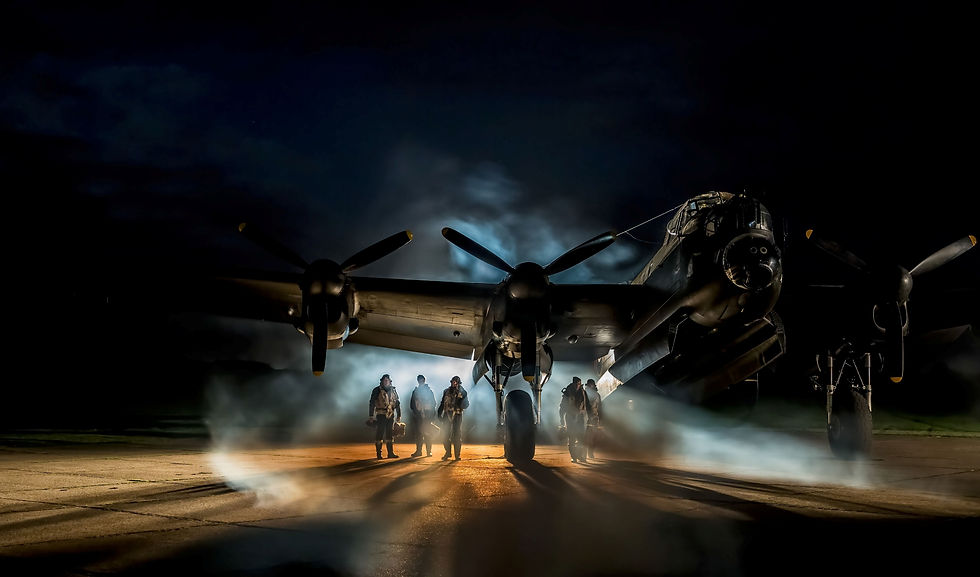
This was the longest-resident unit at Blyton, arriving in 1943 to train crews on heavy bombers like the Lancaster and Halifax. The Badge: Unlike frontline squadrons, Heavy Conversion Units typically did not have an official heraldic badge granted by the College of Arms. Instead, they used the standard RAF crest or the badge of No. 1 Group, Bomber Command, which featured a sheaf of arrows.
Aircraft Markings: You would have seen aircraft at Blyton with the squadron code "PE" painted on the side, which was the unique identifier for 1662 HCU.


During September to November 1942, the Air Bomber Training Flight of No. 1 Group also operated from Blyton, further emphasizing the station’s focus on training and crew preparation.


To complement the HCU, ‘B’ Flight of No. 1 Lancaster Finishing School (LFS) was based at Blyton from November 1943 to February 1944. The LFS provided final conversion and operational readiness training for Lancaster crews, ensuring they were fully prepared for front-line service. The station also hosted other training and holding units, such as No. 7 Air Crew Holding Unit (AHU), which accommodated aircrews awaiting further posting or training. By now with all the heavy bombers using the airfield, the runway was starting to show signs of heavy wear and tear. So the decision was made to reduce the amount of aircraft at the airfield. This in turn led to No.1 LFS leaving the airfield on the 12th February 1944, leaving only 1662 HCU operating from the station.
At Blyton, No. 2797 Squadron RAF Regiment was tasked with airfield defense, ensuring the security of personnel, aircraft, and infrastructure. The regiment’s presence was vital, especially given the concentration of valuable training assets and the risk of enemy action or sabotage.


Maintenance and Refresher Training
From March 1946, Blyton became a sub-site for No. 61 Maintenance Unit (MU), which managed storage and maintenance of surplus equipment and aircraft. In September 1951, the airfield was reactivated as a Relief Landing Ground for No. 101 Flying Refresher School (FRS), which operated Vickers Wellingtons and Gloster Meteors. This unit was later redesignated No. 215 Advanced Flying School (AFS), focusing on jet training with Meteors until May 1954.
Final Closure and Disposal
RAF Blyton was officially closed in May 1954 and returned to Care and Maintenance. No. 61 MU continued to use the site until 1959, after which the airfield was progressively sold off. By 1963, the entire site had been disposed of, with most buildings demolished and the land largely returned to agriculture. The northern part of the airfield, however, found a new lease on life as a motorsports venue, now known as Blyton Park Driving Centre. A memorial plaque near the race track office commemorates those who served at the station.

